
Pasadena
Breast Reduction Pasadena
Breast reduction for women across Pasadena and the San Gabriel Valley — relieving neck, back and shoulder strain, with PPO coverage explained plainly, by a female board-certified plastic surgeon.
Is breast reduction in Pasadena covered by insurance?
It can be, when the reduction is medically necessary and the carrier's minimum tissue removal is met. Dr. Wai-Yee Li, a female board-certified plastic surgeon in Pasadena and Arcadia, is not in network with any plan but works with PPO insurance out of network where the plan allows it; patients may also pay directly with no minimum.
Breast reduction is one of the most consistently life-changing operations Dr. Wai-Yee Li performs, and it is the procedure Pasadena patients most often ask about in the same breath as their insurance card. Both questions belong together. A reduction removes excess breast tissue, fat and skin, lifts and reshapes what remains, and moves the nipple to a higher, more youthful position — and when the breasts are causing real physical symptoms, some PPO plans will help pay for it. This page explains how Dr. Li approaches breast reduction for women across Pasadena and the San Gabriel Valley, what insurance does and does not cover, and what to expect from consultation to recovery.
Dr. Li sees patients at her Pasadena office on South Arroyo Parkway and at LA Breast & Body in Arcadia. For a fuller discussion of the surgery itself — the pedicle techniques, oncoplastic reduction, and the science behind it — her main breast reduction page goes deeper. This page is written for the practical questions Pasadena patients bring to their first visit.
Is breast reduction covered by my PPO?
Sometimes — and only when the reduction is treated as medical, not cosmetic, and strict rules are met. Insurance carriers authorize a breast reduction when the surgeon documents symptoms of 'symptomatic macromastia' and commits to removing a minimum amount of breast tissue. The most widely used yardstick is the Schnur Sliding Scale, which sets that minimum according to your body surface area, calculated from your height and weight. Each carrier then adds its own criteria, which are frequently stricter than Schnur — some require a flat minimum, such as 500 grams per breast, regardless of your frame.
Dr. Li has seen surgeons chase those thresholds at the expense of the result, and she does not believe operating to an arbitrary weight target produces the best breast. If you meet the criteria for an insurance-covered reduction, she and her team are experienced in navigating the authorization process and will help you through it — never at the cost of a poor outcome. Where the criteria are not met, or where you would simply rather not be bound by a minimum, some patients choose to pay for surgery directly, in which case no minimum amount of tissue needs to be removed.
One point to understand before you call: Dr. Li is not in network with any insurance plan. Together with her team, she works with PPO insurance as an out-of-network surgeon, provided your plan includes out-of-network benefits and you are able to use them. Dr. Li is not a Medicare provider. If you are unsure what your plan allows, bring your insurance details to your consultation — or send them ahead through the appointment request form — and our team will review what your PPO is likely to cover before you commit to anything.
Who is a candidate for breast reduction?
If you feel your breasts are too large for your frame and you are healthy enough for general anesthesia, you are very likely a candidate. Most women who come to Dr. Li for a reduction describe the same cluster of symptoms, which doctors group under the term 'symptomatic macromastia':
- Chronic neck, shoulder or back pain that improves only when lying down
- Shoulder grooving — a permanent indentation where the bra strap carries the weight of the breasts
- Skin irritation, rashes or recurring fungal infection ('intertrigo') in the fold beneath the breast
- Difficulty exercising, running or finding clothes and swimwear that fit
- Breasts that have elongated and dropped under their own weight, losing the natural teardrop shape
Two practical requirements apply to everyone. If you smoke or vape, you will need to stop completely — including nicotine gum and patches — for a minimum of eight weeks before surgery, because nicotine blocks wound healing. And if you are of mammogram-screening age, forty and above, Dr. Li asks for a mammogram within the six months before surgery, so that nothing unexpected is found on the operating table. The tissue removed during your reduction is weighed, documented, and sent to pathology as a matter of routine.
What does Dr. Li's breast reduction involve?
The goal is a smaller, lighter breast that is also better shaped. During surgery Dr. Li removes breast tissue and excess skin, reshapes the remaining tissue, and repositions the nipple higher on the breast. To keep the nipple alive it must stay attached to its blood supply on a column of tissue known as the 'pedicle', and there are several pedicle designs depending on how much tissue needs to be preserved. In the rare case of very, very large breasts where the nipple cannot be kept on its own blood vessels, a 'free nipple graft' allows it to be lifted off and sewn back into its new position once the breast is reshaped.
Because skin has to be removed to fit the smaller breast, there will be scars. The usual pattern is the 'anchor' — around the areola, straight down, and along the fold beneath the breast where the wire of a bra sits. When less lower skin needs removing, a shorter 'lollipop' scar may be enough. Dr. Li closes every breast with hidden dissolvable stitches so the scars settle into fine lines, and in the majority of patients they fade with time.
Two refinements are often part of the same operation. The areola, which stretches wide as a large breast grows, is reduced in proportion to the new breast — most patients want this and it is usually included. And the 'axillary rolls' of accessory breast tissue that spill over a bra or strapless dress in the armpit can be treated at the same time, with liposuction when the excess is minor, or a small separate incision when there is skin to remove as well.
Your consultation in Pasadena
Your first visit is unhurried. Dr. Li begins by listening — where you are now, the size you hope to be, what bothers you most — and then takes a full medical, surgical and social history, including smoking. She examines you, takes standard breast measurements, and photographs your upper body for your chart, excluding your head and face. Then she explains the risks and benefits, the steps of surgery, and what she recommends for you specifically, using photographs and diagrams so that you leave understanding the plan, not just agreeing to it.
Many patients bring a partner, a sister, a mother or a close friend — especially younger patients. It helps to bring photographs of the result you have in mind. LA Breast & Body is an all-female practice, and Dr. Li built it that way after years of hearing women describe feeling intimidated or embarrassed in other surgeons' offices. Patients consistently tell us the consultation was comfortable and educational — which is exactly the intention.
Recovery after breast reduction
Patients are surprised by how manageable the recovery is. During surgery Dr. Li places intercostal nerve blocks — a long-acting local anesthetic, typically effective for around five days, injected along the nerves that supply the breast — so you should not wake in severe pain. You will have a drain on each side, a slim tube that carries away fluid so it cannot collect and cause infection, and a light surgical bra over your dressings. Most patients go home the same day.
In the first week you will be sore but not in pain, able to shower from the day after surgery, and asked not to drive, and not to lift anything over five pounds for the first four weeks. Dr. Li or her team see you in clinic that week, and the drains may come out at that visit. By four to six weeks most patients are back at work and driving, with light upper-arm weights allowed but no chest exercises yet; our team can supply return-to-work paperwork if you need it. At three months you can expect to be fully back to normal activity, including exercise.
The particular risks of a reduction, beyond those of any operation under general anesthesia, are changes in breast sensation, which can be permanent, and a reduced ability to breastfeed, since less milk-producing tissue remains. Slow healing at the bottom of the 'T' where the incisions meet is the commonest minor problem and is managed simply with dressings and creams under Dr. Li's guidance.
Breast reduction for teenagers and young women
Severe breast enlargement can begin in adolescence, and for a teenager the physical and social strain can shape those years. Dr. Li trained in craniofacial and pediatric plastic surgery after her residency at the University of Southern California, and she has treated teenage girls with breast asymmetry and hypertrophy throughout her career. As a mother of two daughters, now young adults, she knows the extra care involved, and she performs reduction for adolescents with the family involved at every step. Her adolescent and congenital breast surgery page explains how these consultations work.
Why Pasadena patients choose Dr. Li
Dr. Li is a female board-certified plastic surgeon who spent a decade at a busy cancer center in Southern California before founding LA Breast & Body. That background matters for a reduction: she has performed a great many standard reductions, oncoplastic reductions carried out on the day of a lumpectomy, and symmetrizing reductions where one breast is reduced to match the other. She holds a PhD in wound healing, publishes and reviews for plastic surgery journals, and serves as volunteer faculty at Huntington Memorial Hospital in Pasadena, where she teaches the next generation of surgeons.
Breast reduction carries one of the highest satisfaction rates of any cosmetic procedure, and the most common regret her patients voice is that they waited so long. If you have been putting it off while you work out what your insurance will do, that is the conversation to have first — and it is one our team has every week.
Getting to us from Pasadena and the San Gabriel Valley
Dr. Li's Pasadena office is at 675 South Arroyo Parkway, Suite 310B, on the corridor where the 110 arrives in the city, a few minutes from Old Pasadena and Huntington Hospital. Her Arcadia office at 624 West Duarte Road, Suite 101a, is a short drive east along the 210. Both serve patients from Pasadena, South Pasadena, San Marino, Altadena, Sierra Madre, La Cañada Flintridge, Alhambra, Glendale, Monrovia and the wider San Gabriel Valley, and a South Pasadena office is coming soon. Reach either office by phone or text on 626 888 9728, or request a consultation online and tell us the best time and way to reach you.
Patient stories
What patients say about breast reduction
For years, I had been thinking about getting a breast reduction due to the constant back and neck pain, my poor posture, and the moments of low self-esteem that came with it. It wasn’t an easy decision, but everything changed after my consultation. Dr. Li was incredibly kind, patient, and understanding. She truly listened to my concerns and took the time to explain the entire procedure in detail—what to expect, the process, and the results I could achieve. That conversation gave me the reassurance and confidence I needed to move forward. From before the surgery to after, Dr. Li and her staff made sure I felt supported every step of the way. On the day of the procedure, they made me feel calm and cared for, which meant so much because I was naturally nervous. My recovery process was better than I expected. Dr. Li and Traci were very attentive during my follow-up visits, making sure I was healing properly and always addressing any concerns I had. I never felt alone during this journey. The results have truly been life-changing for me—not just physically, but emotionally as well. I feel more comfortable in my body, more confident, and finally free from the daily discomfort I used to experience. I am incredibly grateful to Dr. Li and her team for their skill, care, support, and dedication. Choosing to have this surgery was one of the best decisions I’ve ever made, and I highly recommend Dr. Li to anyone considering breast reduction. You will truly be taken care of.
I have had a wonderful experience and results with Dr. Wai-Yee Li. I used Dr. Li for a breast reduction and she listened carefully to understand my preference for size. She explained my options, and how the procedure would be carried out, called me afterward, to make sure things were going well and performed follow-ups to ensure my healing was on track. My breasts turned out exactly as I wanted! My nipples were perfectly placed with no scarring, and I healed up quickly and with minimal pain. I have also used Dr. Li for cosmetic procedures, including fillers and botox, and they look natural and beautiful. I can’t say enough about Dr. Li’s talent, her care and consideration for her patients. Feel so lucky to have Dr. Li and her all-woman team in LA!
Not sure which option is right for you? Understand your options ›
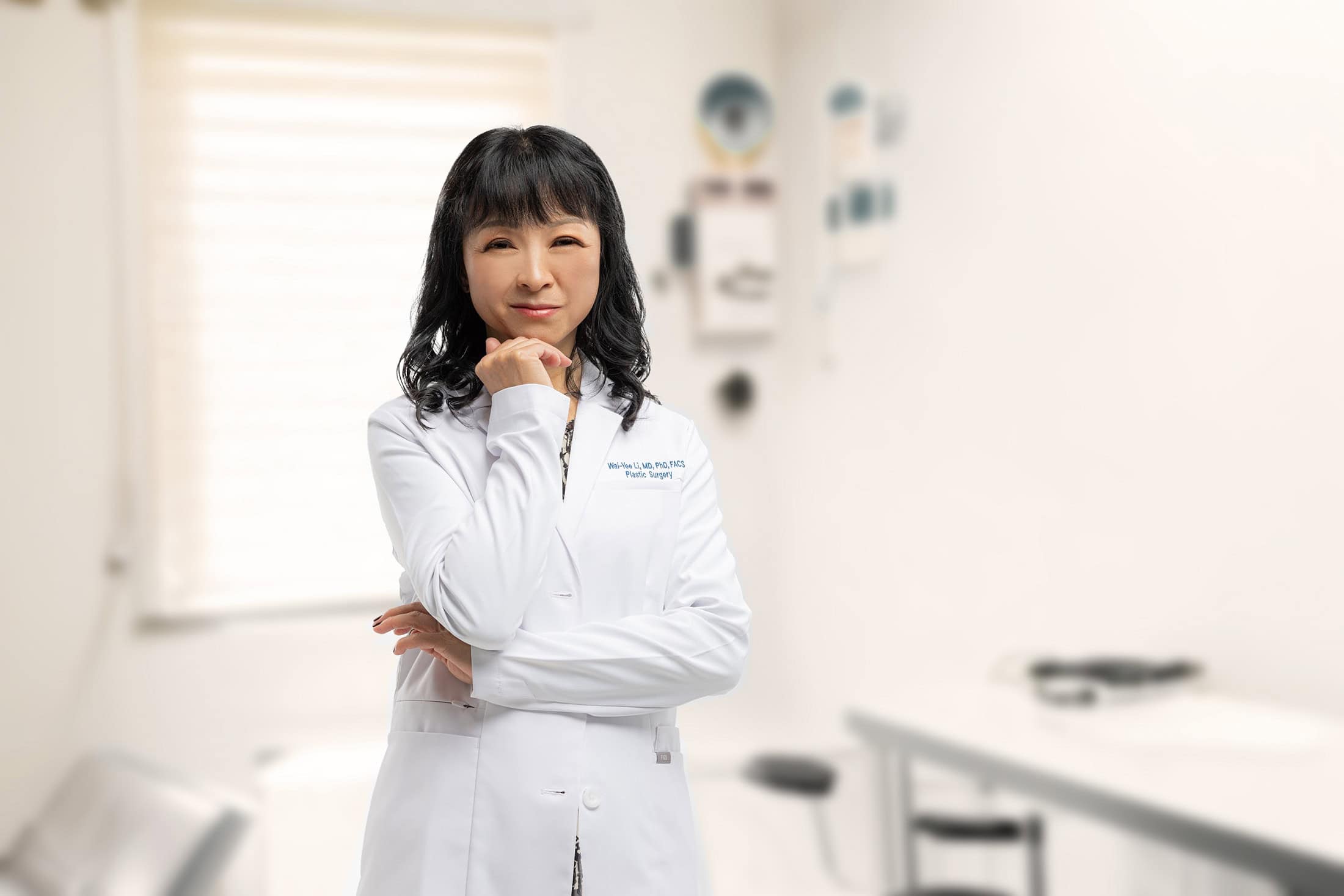
Meet your surgeon
Dr. Wai-Yee Li,
MD PhD FACS
A female board-certified plastic surgeon in Arcadia, Los Angeles, specializing in aesthetic and reconstructive breast surgery — with a focus on the best surgical outcomes, less pain and minimal scarring.
Meet Dr. Wai-Yee Li ›



Patient reviews
Rated 5.0 from 227+ reviews across Google, Yelp, Healthgrades & U.S. News
Read patient reviews ›Take the next step
Considering breast surgery?
Book a consultation with Dr. Wai-Yee Li, or call the practice to discuss your options.
Visit the practice
Two locations across Los Angeles
Arcadia
Get directions ›Pasadena
Pasadena, CA 91105