
Lipoma Removal
How are lipomas removed?
Lipomas — benign fatty lumps — are removed whole under local anesthetic through the shortest incision the lump allows, closed in layers for the smallest possible scar. Dr. Wai-Yee Li removes them in the office, serving Arcadia, Pasadena, and South Pasadena.
A lipoma is a benign lump of fatty tissue that sits just under the skin — soft, movable, usually painless, and slow-growing. Most lipomas are harmless and never need treatment, but one that is large, tender, pressed on by clothing, or simply unwelcome can be removed. Dr. Li removes lipomas whole under local anesthetic in the office, closing each one in layers for the smallest possible scar, and sees patients from across Arcadia, Pasadena, and South Pasadena.
What is a lipoma?
A lipoma is a benign — non-cancerous — growth of fat cells that forms a soft lump in the layer of tissue just beneath the skin. It usually feels soft and slightly doughy, moves a little when you press on it, and is painless most of the time. Lipomas tend to grow slowly, over months or years, and many people live with one for a long while before deciding to have it looked at.
They are one of the most common benign lumps found under the skin, and they can appear almost anywhere on the body. The most frequent spots are the back, shoulders, neck, arms, and trunk. Lipomas are more common in adults than in children, and a tendency to develop several can run in families. Some people have a single lipoma; others develop more than one. Having one is not a sign of anything dangerous — a lipoma is simply fat that has collected into a discrete lump instead of lying in a normal, even layer.
Why do people have lipomas removed?
Most lipomas are removed for practical or personal reasons rather than out of medical necessity, because the lump itself is benign. A lipoma does not turn into cancer over time, so simply watching it is a legitimate choice — removal is about comfort, appearance, or certainty, not about heading off a future danger. A few reasons come up again and again:
- Size. A lipoma that has grown large enough to show under clothing, or to change the shape of an area, is often removed for that reason alone.
- Discomfort or pressure. Lipomas near a joint, under a bra strap or waistband, or over a bony area can be tender and can catch or press with movement.
- Appearance. A lump on the face, neck, or another visible area is a cosmetic concern for many people, even when it is small.
- Change. A lipoma that begins growing faster, turns firm, or changes in any way is worth removing so the tissue can be examined.
- Diagnostic certainty. Some people simply want to know for certain what a lump is — removing it and sending the tissue to pathology answers that question definitively.
There is no obligation to remove a lipoma that does not bother you. The decision is yours, and a consultation is where Dr. Li helps you weigh it honestly against your goals.
When should a lump be checked by a doctor?
Any lump that is growing, painful, firm, fixed in place, or changing should be evaluated by a doctor rather than assumed to be a harmless lipoma. A classic lipoma is soft, movable, and slow-growing — but not every lump under the skin is a lipoma, and the only way to be sure is an in-person examination and, when needed, removal with pathology.
This is where Dr. Li's background matters. She spent ten years at a busy cancer center in southern California, where she removed many skin cancers and closed the wounds with a plastic surgeon's technique, so she examines a lump with a trained eye for the features that deserve a closer look. Very occasionally a fatty lump turns out to be something other than a simple lipoma, and that possibility — small as it is — is exactly why examination and, when tissue is removed, pathology belong in a careful approach.
How does Dr. Li remove a lipoma?
Dr. Li removes a lipoma by excision — taking the whole lump out through a planned incision — under local anesthetic in the office. Because a lipoma has a fairly clear edge against the surrounding tissue, it can usually be freed and lifted out in one piece. Removing it whole is the goal, because a lump taken out completely is unlikely to return in the same place.
What sets her approach apart is the closure. As a board-certified plastic surgeon, Dr. Li treats a lipoma removal with the same care she brings to reconstructive surgery: she plans the incision along the skin's natural lines, keeps it as short as the lump allows, and closes it in layers so the surface heals as a fine line. Depending on the site, the stitches may be dissolvable or may be removed at a short follow-up visit. A general practitioner can remove a lipoma — the difference a plastic surgeon brings is in where the scar is placed and how carefully it is closed. That matters most on the face, neck, and other areas that show.
One honest point: no removal is scarless. Any time the skin is opened it leaves some mark. The aim is the smallest, best-placed scar the lump allows — not the impossible promise of none.
What is the in-office experience like?
Lipoma removal is an in-office procedure performed under local anesthetic — there is no hospital, no operating room, and no general anesthesia. The area is numbed, so you stay awake and comfortable throughout, and you drive yourself home afterward. For a benign lump just beneath the skin, this is a low-key, straightforward procedure rather than a hospital event.
The practice is an all-women environment, from the front desk to the surgeon, which many patients find more comfortable — particularly when a lipoma sits in a private or sensitive spot. If you have more than one lipoma, several can often be removed in the same visit; it is worth mentioning when you book so enough time is set aside, much the way Dr. Li plans removing multiple neurofibromas in one session.
Is the removed tissue examined?
Yes — removed tissue can be sent to pathology for confirmation, and Dr. Li goes through the result with you plainly. Even though a typical lipoma is benign, examining the tissue confirms exactly what the lump was rather than leaving it assumed, which is both reassuring and good standard of care. The result usually confirms a benign lipoma; in the rare case it shows something else, having already removed it and examined it means you have an answer and a plan. It is the same principle that makes a plastic surgeon a sound choice for skin cancer and mole removal — the lesion comes off, and the diagnosis is confirmed.
What is recovery like?
Recovery from a minor skin excision is usually straightforward, though it varies from person to person and with the size and location of the lipoma. Dr. Li and her team give you wound-care instructions specific to your situation and guide you through healing — there is no single timeline that fits every lump, so the guidance is tailored rather than generic.
In general terms, you keep the area clean and protected while it heals, avoid straining the site early on, and ease back into normal activity. Contact the office if you notice increasing redness, swelling, warmth, or drainage — the ordinary signs of healing settle rather than worsen. A scar continues to mature and fade over the months following any excision, and Dr. Li will tell you what to expect for your incision and how to care for it so it has the best chance of healing well.
What happens at a lipoma consultation?
At the consultation, Dr. Li examines the lump, asks how long it has been there and whether it has changed, and talks through whether removing it makes sense for you. If you decide to go ahead, she plans the incision and explains what the scar is likely to look like given the lump's size and location. There is no pressure to treat a lipoma that is benign and not causing you trouble — the visit is as much about deciding whether to act as it is about how.
The practice is not in-network with insurance. For a medically indicated removal, some patients use out-of-network PPO benefits, while others choose to pay directly. The consultation is the place to sort out the practical details, so you know what to expect before anything is scheduled.
Why choose Dr. Li for lipoma removal?
Dr. Li is a board-certified plastic surgeon — MD, PhD, FACS — whose career has centered on reconstruction and cancer care. She completed her residency at the University of Southern California and a fellowship in craniofacial and pediatric plastic surgery, and spent ten years at a busy southern California cancer center where removing lesions and closing the wounds cleanly was routine work.
For something as common as lipoma removal, that background is the whole point. The removal itself is simple; the value lies in the judgment about which lumps deserve a closer look and in the reconstructive closure that gives the scar its best chance to fade. You can read more about Dr. Li's training and background before your visit.
To find out whether removing your lipoma is right for you, book a consultation with Dr. Li in Arcadia or Pasadena, or call 626.888.9728.
Frequently asked questions
Lipomas are benign fatty lumps. They are removed because they are visible, tender, or growing — and removed tissue can be sent to pathology for confirmation, with results explained plainly.
Usually yes — mention it at consultation so the session is planned with enough time.
Any excision leaves a mark; the goal is the smallest one possible. Dr. Li removes the lipoma through the shortest incision it allows, placed along the skin's natural lines and closed in layers so it heals as a fine line.
When a lipoma is removed whole, it is unlikely to return in the same place, because taking out the entire lump — rather than only part of it — is what keeps recurrence uncommon. People who are prone to lipomas can still form a new one elsewhere, but that is a separate growth, not a regrowth of the one removed. Dr. Li removes each lipoma in one piece for exactly this reason.
No. Dr. Li removes lipomas under local anesthetic in the office — the area is numbed, you stay awake and comfortable, and there is no hospital, operating room, or general anesthesia. When the procedure is done you drive yourself home. For a benign lump just beneath the skin, this in-office approach is straightforward and avoids the added recovery of going under.
You cannot be certain from the outside, which is why any lump that is growing, painful, firm, or fixed in place should be examined in person. A classic lipoma is soft, movable, and slow-growing, but only an examination — and, when tissue is removed, pathology — confirms it. Dr. Li’s years at a cancer center inform that assessment.
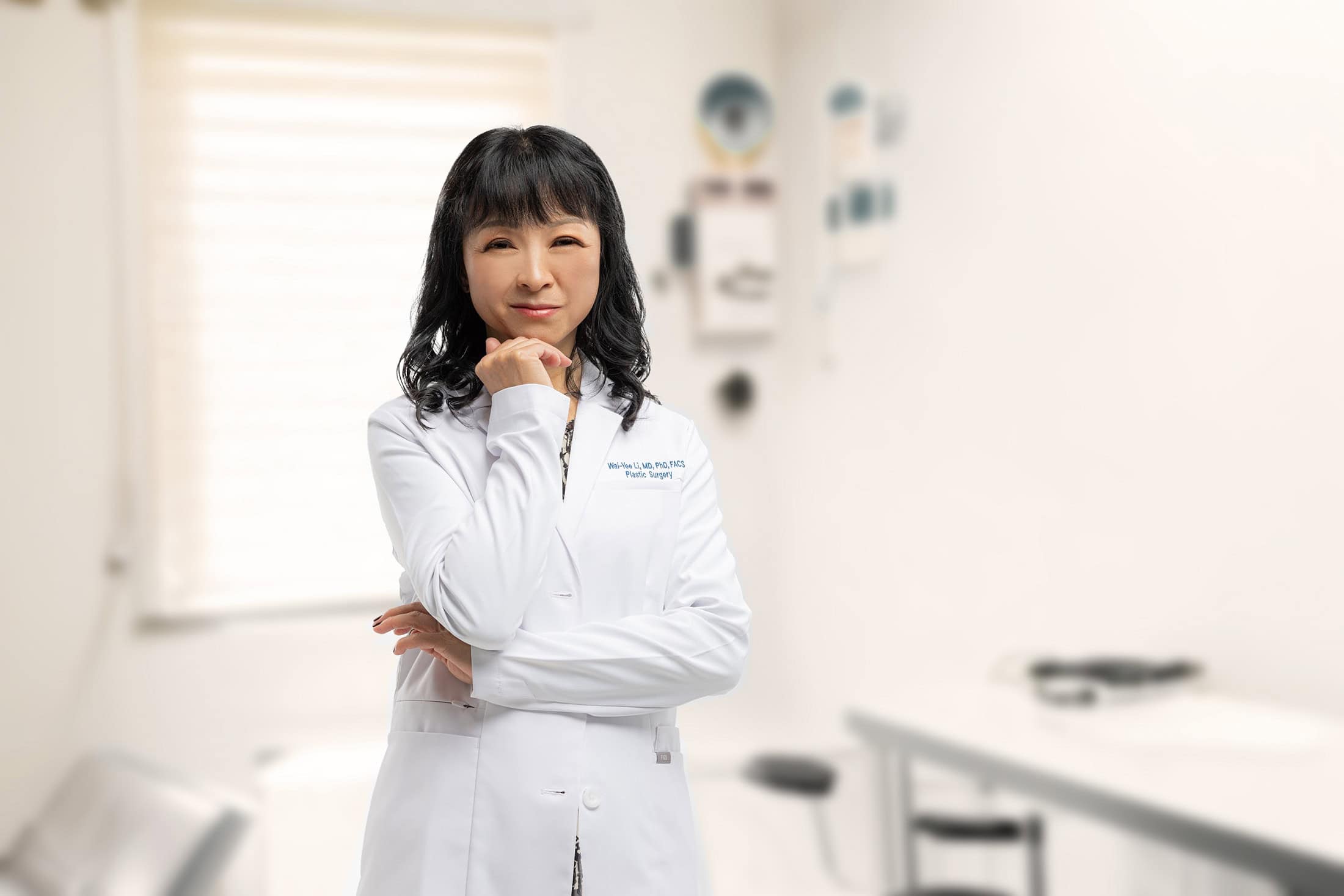
Meet your surgeon
Dr. Wai-Yee Li,
MD PhD FACS
A female board-certified plastic surgeon in Arcadia, Los Angeles, specializing in aesthetic and reconstructive breast surgery — with a focus on the best surgical outcomes, less pain and minimal scarring.
Meet Dr. Wai-Yee Li ›



Patient reviews
Rated 5.0 from 227+ reviews across Google, Yelp, Healthgrades & U.S. News
Read patient reviews ›Take the next step
Considering breast surgery?
Book a consultation with Dr. Wai-Yee Li, or call the practice to discuss your options.
Visit the practice
Two locations across Los Angeles
Arcadia
Get directions ›Pasadena
Pasadena, CA 91105