
Revision Augmentation
What does revision breast augmentation correct?
Revision augmentation corrects problems after previous breast implant surgery — capsular contracture most commonly, plus implant malposition, rupture, or a change in size — using the reconstructive techniques Dr. Wai-Yee Li has refined over thousands of breast operations in Los Angeles.
Revision breast augmentation corrects problems that develop after a previous breast implant surgery. The most common reason women come to Dr. Li is capsular contracture — hardening of the scar tissue around an implant — but women also return to exchange aging implants for new ones, to change size, to fix an implant that has shifted out of position, or because an implant has ruptured. Because the breast has already been operated on, a revision is really a form of reconstruction: Dr. Li rebuilds a result on tissue and a pocket that already carry the imprint of the first surgery, using the reconstructive techniques she has refined over thousands of breast operations.
What is capsular contracture?
Capsular contracture is the single most common reason women seek a revision, so it is the right place to start. Scar tissue naturally forms a thin capsule around every breast implant — that is normal, expected, and usually causes no trouble at all. In some breasts, though, the capsule thickens and tightens over time. As it contracts, it squeezes the implant, and the breast can begin to feel firm or hard, look rounder or distorted, ride too high on the chest, or ache.
When contracture is the problem, treatment usually means removing or releasing the tightened scar capsule — a 'capsulectomy' when the capsule is taken out entirely — and then either exchanging the implant for a new one or removing the implant altogether. The right choice depends on how thick or calcified the capsule has become, whether the implant is still intact, the quality of your own tissue, and what you want your breast to look like afterward. There is no single recipe; the plan is built around your breast.
One reason to choose a breast specialist for this is that the surgical plan itself can influence whether contracture returns. Dr. Li operates in both the 'subpectoral' plane (under the chest muscle) and the 'prepectoral' plane (in front of it), with hundreds of cases in each. Prepectoral placement is more anatomical — the implant sits where the breast tissue naturally lives — and in her reconstructive experience it tends to be associated with less capsular hardening, particularly in breasts that have been through radiation. At a revision, changing the implant's position, surface, or the implant itself may all be part of lowering the odds of a repeat.
Breast implant exchange and replacement
Breast implants are not lifetime devices, and one of the most common revisions Dr. Li performs is a straightforward exchange — old implants out, new implants in. Many women had a breast augmentation years, sometimes decades, ago. They are often happy overall, but eventually reach a point where the implants are aging, their goals have changed, or a new problem has appeared. Exchanging the implants is how that chapter gets updated.
Women return for an implant exchange for several reasons:
- Aging implants. Implants do not last forever. Even without a specific complication, an older implant may be reaching the point where replacement is sensible, and a revision is the chance to swap it for a current device.
- A change in size or shape. Bodies and preferences change. Some women want to go smaller after years with larger implants; others want a more natural profile, or a modest increase. An exchange can adjust the implant's size, projection, and shape in one operation.
- Moving away from an older or textured implant. 'Textured' implants — made with a rough surface coating to reduce contracture — have been linked to a rare cancer called anaplastic large cell lymphoma (ALCL), and in 2019 the FDA requested that Allergan recall its Biocell textured implants. Dr. Li does not use textured implants and never has, so a revision is a natural opportunity to exchange an older or textured device for a smooth one.
- Correcting a problem at the same time. An exchange is frequently combined with treating capsular contracture or replacing a ruptured implant, so the aging device and the underlying issue are addressed together rather than in two separate operations.
An exchange is also the moment to refine the result, not just replace hardware. If your original implants left visible rippling or firm edges — most noticeable in thinner women who have little tissue over the implant — Dr. Li can often soften them with fat grafting, moving a small amount of your own fat to blur the implant's border. And if the skin has stretched over the years so the breast has begun to sag, an exchange can be paired with a breast lift (mastopexy) to reshape the breast around the new implant.
What is implant malposition?
Implant malposition means the implant has settled into the wrong position on the chest. It can develop gradually as tissues stretch and gravity does its work, or it can trace back to how the original pocket was made. Either way, it is a common and correctable reason for revision. The patterns Dr. Li sees most often include:
- Bottoming out. The implant drops below the natural breast fold — the 'inframammary fold', or IMF — so the implant sits low while the nipple appears to point upward.
- Symmastia. The pockets meet across the middle of the chest, so the implants look joined over the breastbone rather than separate.
- Lateral displacement. The implants drift toward the sides, especially when you lie down, leaving a wide gap in the center.
- A result that never sat right. Asymmetry, one implant higher than the other, or a shape that never matched what was intended at the first surgery.
Correcting malposition usually means repairing the pocket that holds the implant — reinforcing, tightening, or resizing it, sometimes with internal sutures or added support — and exchanging the implant when that is part of the fix. As with contracture, Dr. Li plans the repair around your specific anatomy rather than applying one standard approach.
What about a ruptured implant?
Sometimes the reason for a revision is a ruptured implant. A saline implant tends to announce itself: it deflates, the salt water is harmlessly absorbed by your body, and the breast visibly softens or shrinks within a day or two. A silicone rupture is often 'silent' — the gel stays in place, the breast can look unchanged for years, and it is imaging, usually ultrasound or MRI, that confirms it.
Dr. Li examines the breast and, when a silent rupture is suspected, arranges the right imaging; she offers high-resolution ultrasound in her office. If a rupture is confirmed, the fix is the same operation described throughout this page — removing the old implant and replacing it, or removing it altogether. For a fuller explanation of the warning signs and the first test she orders, see the dedicated breast implant rupture page.
Dr. Li's approach to revision breast surgery
Dr. Li treats a revision as reconstruction, because that is what it is. She spent ten years at a busy cancer center rebuilding breasts, and she brings the same reconstructive judgment she uses in breast reconstruction to a cosmetic revision. Importantly, she specializes specifically in revision breast surgery — removing ruptured implants, correcting capsular contracture, and reshaping breasts left asymmetric by a previous operation are a regular part of her practice, not an occasional exception. That background shapes a few consistent principles:
- Smooth implants only. Because of the link between textured implants and ALCL, Dr. Li does not use them, and a revision is often the moment to exchange an older textured device for a smooth one.
- Comfort in both planes. With hundreds of subpectoral and hundreds of prepectoral cases behind her, she can advise whether keeping the implant where it is, or moving it to a different plane, gives the more durable result.
- The capsule is part of the plan. Whether the scar capsule is removed, partly removed, or released depends on how thick, calcified, or rupture-affected it is — decided from your tissue, not a template.
- Your own tissue where it helps. Fat grafting to soften an implant edge, or a lift to reshape a stretched breast, lets her improve the result rather than simply reinstall an implant.
- Honesty about what is realistic. Dr. Li is direct. She will tell you what a revision can achieve and what it cannot before you commit to anything.
Is revision breast augmentation right for me?
Whether revision augmentation is right for you is determined in consultation, not on a web page. Dr. Li examines your breasts, reviews your surgical history and any records or imaging you can bring, listens to what is actually bothering you, and lays out the options honestly — including, at times, that waiting or doing nothing surgical is the wiser choice for now. Candidacy is a conversation, and it is decided in person.
As with any breast surgery, healthy healing matters to the outcome. Nicotine in every form — cigarettes, vaping, nicotine gum, and patches — restricts blood flow and interferes with wound healing, so Dr. Li asks patients to stop for at least eight weeks before surgery. Your overall health, your previous operation, and your reasons for wanting a revision are all reviewed together before anything is scheduled.
What to expect
Revision augmentation is a surgical procedure, usually performed under general anesthesia. What actually happens in the operating room varies with the reason for the revision — a simple implant exchange is a smaller undertaking than removing a thick capsule, correcting malposition, or adding a lift — so Dr. Li builds the plan around your situation and walks you through it beforehand, including the trade-offs of each option.
Recovery follows the same logic. Because every revision is different, there is no single timeline that fits all of them; Dr. Li and her team guide you through aftercare and follow-up, and most patients return to normal activity gradually. She offers her patients long-term follow-up and is candid about the fact that any implant — including a brand-new one — is not permanent and benefits from ongoing monitoring over the years.
Revision augmentation after cosmetic surgery is generally a self-pay procedure. LA Breast & Body is not in-network with insurance, though where a medical problem such as a rupture is involved, the office can review out-of-network PPO benefits on a case-by-case basis. The team is glad to talk this through directly rather than leave you guessing.
Why choose Dr. Li for a revision
Dr. Wai-Yee Li is a female, board-certified plastic surgeon — MD, PhD, FACS — whose surgical life centers on the breast. After ten years at a busy cancer center, where she reconstructed breasts, corrected implant complications, and removed many skin cancers, she opened her own solo, all-women practice, LA Breast & Body, in Arcadia and Pasadena. A revision asks a surgeon to solve someone else's result on tissue that has already been changed — which is precisely the reconstructive problem she has spent her career on. Patients often say the all-women environment makes a personal surgery feel easier, and Dr. Li's honesty is part of the point: she will tell you what is realistic before you decide, not after.
To find out whether revision breast augmentation is right for you, book a consultation with Dr. Li in Arcadia or Pasadena, or call 626.888.9728.
Frequently asked questions
Scar tissue naturally forms a capsule around every implant; in some breasts it tightens over time, making the breast feel firm, look distorted, or ache. Treatment usually removes the contracted capsule and replaces or removes the implant.
Silicone ruptures are often silent — imaging such as ultrasound or MRI confirms it. The breast implant rupture page explains the signs and the first test Dr. Li orders.
Yes. Many revisions end with removal — often paired with a lift or fat grafting so the breast keeps a shape you are happy with.
Implants are not lifetime devices, so many women eventually return to have older implants exchanged — old ones out, new ones in — whether or not a specific problem has appeared. An exchange is also a chance to change size, switch to a smooth implant, or soften rippling with fat grafting. Dr. Li explains what monitoring and eventual replacement can involve before you decide, not after.
Yes. A revision is a common time to change size — going smaller after years with larger implants, choosing a more natural profile, or making a modest increase. Dr. Li can adjust the implant’s size, projection, and shape, and when the skin has stretched she can add a breast lift so the new size sits well. What suits your tissue is decided together at your consultation.
Treatment usually means removing or releasing the tightened scar capsule and then either exchanging the implant for a new one or removing it. The exact plan depends on how thick or calcified the capsule is, whether the implant is intact, and your goals for the breast afterward. Because the implant’s position can affect whether contracture returns, Dr. Li discusses the surgical plane as part of the plan.
Yes — that is called implant malposition, and it is a common, correctable revision. Implants can bottom out below the natural breast fold, drift toward the armpits, or sit too close together in the middle. Correcting it usually means repairing the pocket that holds the implant, sometimes with internal sutures or added support, and exchanging the implant when needed. Dr. Li plans the repair around your anatomy.
Textured implants — made with a rough coating to reduce capsular contracture — have been linked to a rare cancer, anaplastic large cell lymphoma (ALCL), and in 2019 the FDA requested a recall of Allergan’s Biocell textured implants. Dr. Li does not use textured implants and never has. A revision is therefore a natural opportunity to exchange an older or textured device for a smooth one.
Yes. Many patients come to Dr. Li specifically for a revision after an augmentation performed elsewhere. She reviews your history and any records, examines the breasts, orders imaging if a rupture is suspected, and gives an honest assessment of what a revision can and cannot achieve. Revision and reconstructive breast surgery are her focus, so second opinions on previous implant surgery are routine.
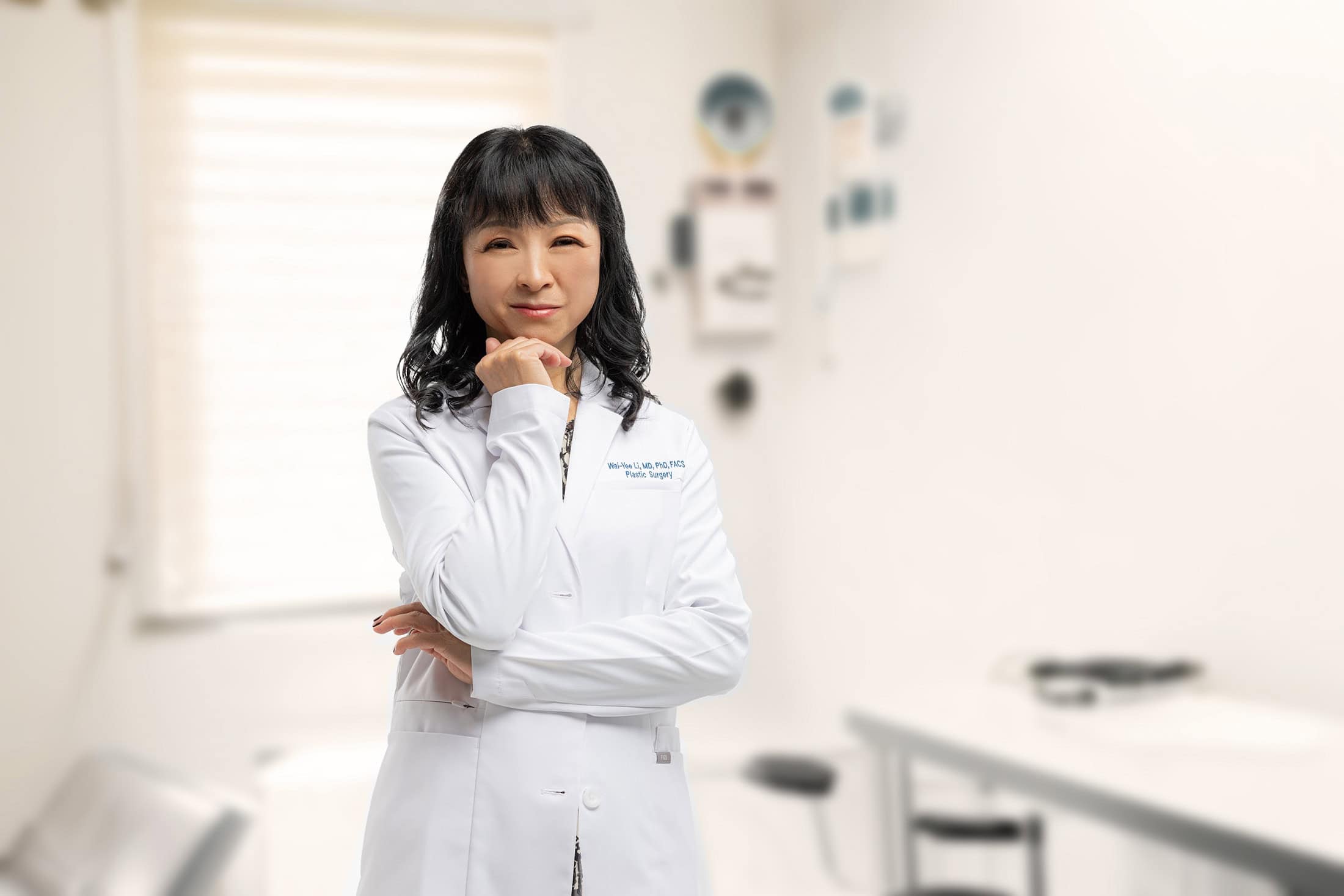
Meet your surgeon
Dr. Wai-Yee Li,
MD PhD FACS
A female board-certified plastic surgeon in Arcadia, Los Angeles, specializing in aesthetic and reconstructive breast surgery — with a focus on the best surgical outcomes, less pain and minimal scarring.
Meet Dr. Wai-Yee Li ›



Patient reviews
Rated 5.0 from 227+ reviews across Google, Yelp, Healthgrades & U.S. News
Read patient reviews ›Take the next step
Considering breast surgery?
Book a consultation with Dr. Wai-Yee Li, or call the practice to discuss your options.
Visit the practice
Two locations across Los Angeles
Arcadia
Get directions ›Pasadena
Pasadena, CA 91105