
Breast Implant Removal
What happens when breast implants are removed?
Breast implant removal takes the implants out, with or without the surrounding scar capsule, always with a plan for how the breast will look afterwards — removal alone, paired with a lift or fat grafting, or an aesthetic flat closure. Dr. Wai-Yee Li plans that with you before anything is scheduled.
Breast implant removal — often called ‘explant’ — takes breast implants out, with or without the surrounding scar ‘capsule,’ and always with a plan for how the breast will look afterward. Women reach this decision for different reasons: hardening of the breast, a suspected rupture, health concerns, or simply because the implants that suited them once no longer do. Dr. Li treats the removal itself as only half the decision. The other half — what the breast becomes next — is planned with you before anything is scheduled.
What is breast implant removal?
Breast implant removal is the surgical removal of one or both breast implants. It can be done on its own or combined with removal of the surrounding scar capsule, a lift, fat grafting, or a new implant — depending on why the implants are coming out and what you want the breast to look like afterward. Every implant, whether it was placed for cosmetic augmentation or for reconstruction after mastectomy, sits inside a layer of scar tissue that the body naturally forms around it. Deciding whether that ‘capsule’ stays or goes is part of planning the operation.
What removal is not is a single fixed procedure. Two women can both have their implants taken out and undergo very different operations, because the goal is not only to remove a device — it is to leave the breast in a shape each woman has chosen in advance. That planning is the part Dr. Li cares most about, and it is why she asks what you want the result to look like before she talks about how the implants come out.
Why do women have their implants removed?
Women choose implant removal for practical, medical, and personal reasons, and often for a combination of them. There is no single ‘right’ reason, and Dr. Li does not treat any of them as more valid than the others. The most common ones include:
- Aging implants. Breast implants are not lifetime devices. As a general guide they are often changed every ten to fifteen years, and the FDA recommends monitoring silicone implants with imaging beginning around five years after placement and every two to three years after that. Many women simply reach a point where their implants are old and they would rather have them out than keep maintaining them.
- Capsular contracture. The scar capsule that forms around every implant can, in some breasts, thicken and tighten over time — a condition called ‘capsular contracture’ that can make the breast feel firm, look distorted, or ache. It is one of the most common reasons for both removal and revision.
- Rupture. A saline implant deflates visibly when it leaks; a silicone rupture is often silent and shows up only on imaging. If you are worried about a leak, the breast implant rupture page explains the signs and the test that confirms it.
- Personal choice. Some women simply no longer want implants — they want to be smaller, to feel more natural, or to be done with the monitoring that implants ask of them. That is reason enough.
- Health concerns. Some women ask about removal because of a broad set of symptoms they have come to associate with their implants, sometimes described as ‘breast implant illness.’ This is a real and widely discussed concern, and it is not dismissed here. At the same time, what the medical evidence can and cannot say about it is still evolving, so Dr. Li will not promise that removal will resolve any particular symptom. What she will do is listen, examine you, explain honestly what is known, and — if you decide to explant — plan the surgery and the appearance of the breast afterward with care.
Removal with new implants, or removal without
Once you have decided the implants are coming out, the first real choice is whether new implants go back in. Both paths are common, and Dr. Li performs both.
Removal with replacement exchanges the old implants for new ones — often called an implant ‘exchange.’ It is a natural choice when the implants are simply old, when a rupture needs correcting, or when you want to change size, change ‘projection’ (how much the implant sticks out), or switch between saline and silicone. Because implants are not lifetime devices, this exchange is something many women return for years after their original breast augmentation. When the plan is to replace rather than simply remove — and especially when there is a capsular contracture or an implant that has shifted out of position to correct at the same time — it is planned as a revision augmentation. Saline implants cost less and, when they leak, deflate and are absorbed by the body; silicone tends to look and feel more natural. Those trade-offs are part of the conversation whenever a new implant is on the table.
Removal without replacement means the implants come out and nothing goes back in. For many women that is the entire goal. But ‘no implant’ is not the end of the plan — the breast that carried an implant for years will not always settle on its own into a shape you are happy with, so the next decision is how to reshape what remains.
What will my breasts look like after removal?
What the breast looks like after removal depends on your own tissue — how large the implants were, how long they were in place, and the elasticity of your skin — and there is a plan for each situation rather than a single default. Skin that was stretched by an implant for years does not always snap back on its own, so Dr. Li discusses the likely result honestly before surgery and matches a reshaping plan to it. The common options, often combined with the removal in a single operation, are:
- Removal alone. For women whose tissue will settle into a shape they are comfortable with, the implants simply come out and no further reshaping is needed.
- Removal with a lift. Pairing removal with a breast lift (mastopexy) lifts and reshapes your own tissue and repositions the nipple, countering the droopiness — ‘ptosis’ — that can follow years of stretching. It is one of the most common combinations.
- Removal with fat grafting. Fat grafting uses your own fat, harvested by liposuction, to restore softness and a little volume without a new implant — useful for smoothing the contour or filling out the upper breast.
- Aesthetic flat closure. For reconstruction patients, or anyone choosing to go without a breast mound, an aesthetic flat closure removes the implant and tidies the tissue and scars into a smooth, comfortable, deliberately flat contour.
No result is guaranteed, and Dr. Li will tell you plainly what she believes each option can and cannot achieve for your anatomy. The aim is that you know, before the operation, roughly what you will see afterward — so the result is a shape you chose rather than one you were surprised by.
Removing the implant with or without the capsule
Whether the scar capsule around the implant is removed — partly, or completely — depends on why the implants are coming out and on the condition of the capsule itself. Removing the capsule is called a ‘capsulectomy’; it can be partial (removing part of the capsule) or complete (removing all of it), and taking the implant and capsule out together as a single unit is sometimes called an ‘en bloc’ capsulectomy. A healthy, thin, soft capsule can often be left in place, because the body gradually reabsorbs it. A capsule that is contracted, thickened, calcified, or affected by a rupture is handled differently and is more often removed.
Some women specifically ask for the entire capsule to be taken out, often connected to the health concerns above. Whether complete removal is advisable is a clinical judgment that also weighs the extent of the surgery, because the capsule sits against the ribs, the chest muscle, and the lining of the lung. Rather than committing to one technique in advance, Dr. Li explains her recommendation and the reasons for it at consultation. Her reconstructive background — where scarred tissue planes and capsules are everyday work — is exactly the experience this part of the operation calls for.
Dr. Li’s approach to implant removal
Dr. Li plans the ‘after’ before she plans the removal. Much of her surgical life is reconstruction and revision — she specializes in revision breast surgery, including removal of ruptured implants and correction of capsular contracture — so taking implants out and rebuilding a good shape is routine work for her, not an unusual request. That reconstructive lens is why she treats a decision like this as being about planning, not just extraction.
She is also honest and direct. She will tell you what a removal can realistically achieve, what it cannot, and where a lift, fat grafting, or a flat closure would serve you better than removal alone. Many women describe genuine relief once implants that were worrying them or feeling hard are out and the breast has a shape they chose. Dr. Li reaches that outcome by planning it carefully, not by promising it — and she does so in a calm, all-women practice where patients often feel more comfortable discussing an intimate decision.
Is breast implant removal right for me?
Whether implant removal — and which plan for the breast afterward — is right for you is decided at a consultation, not on a web page. Dr. Li reviews your history, examines you, discusses why you want the implants out and what you hope the breast will look like, and, where a rupture or contracture is suspected, may arrange imaging before recommending a path. As with any surgery, being in good general health and stopping all nicotine well before the operation — smoking and vaping interfere with wound healing — are part of preparing safely. The consultation is where honest expectations are set, in both directions.
What to expect and recovery
Breast implant removal is a surgical procedure, and what it involves depends on how much is done — removal alone is a smaller operation than removal combined with a capsulectomy, a lift, or fat grafting. Dr. Li will explain the specifics of your operation during your consultation, including whether small drains are used for a time to keep fluid from collecting under the skin, a ‘seroma.’ Recovery likewise varies with what was done: most patients return to normal activity gradually, avoiding strenuous exercise and heavy lifting for a period, guided step by step by Dr. Li and her team. The general risks of surgery — bleeding, infection, scarring, changes in sensation, and asymmetry — apply, and Dr. Li reviews them with you before you decide.
Why choose Dr. Li for implant removal?
Dr. Wai-Yee Li is a female, board-certified plastic surgeon — MD, PhD, FACS — who spent ten years at a busy cancer center handling complex breast surgery before opening her all-women practice, LA Breast & Body. Removing and revising implants, working with capsules and scarred tissue, and rebuilding a natural breast shape are central to her reconstructive experience, not occasional add-ons. Patients often come to her specifically for revision after a first surgery elsewhere left them unhappy. She offers that experience alongside a straightforward manner — she will tell you what is realistic and plan the result with you — in Arcadia and Pasadena.
To find out whether breast implant removal is right for you, book a consultation with Dr. Li in Arcadia or Pasadena, or call 626.888.9728.
Frequently asked questions
Not when removal is planned properly. Depending on your tissue, removal can be paired with a lift, fat grafting, or — for reconstruction patients — an aesthetic flat closure, so the result is a shape you chose.
It depends on why the implants are coming out. Contracted, calcified, or rupture-affected capsules are treated differently from healthy ones; Dr. Li explains her recommendation and the reasons for it at consultation.
Usually yes — removal with a lift or with fat grafting is commonly performed as a single operation.
Not when removal is planned properly. Depending on your tissue, removal can be paired with a lift, fat grafting, or — for reconstruction patients — an aesthetic flat closure, so the result is a shape you chose.
No. Removal without new implants is common, and the breast is reshaped to suit — with a lift, fat grafting, or an aesthetic flat closure. If you do want implants again, removal and replacement — an implant exchange — can be done in the same operation, which is also a good moment to change size or switch between saline and silicone.
Dr. Li will not promise that. The symptoms some women associate with their implants, sometimes called breast implant illness, are a real and widely discussed concern, but the medical evidence about them is still evolving. She takes the concern seriously, examines you, explains honestly what is and is not known, and if you choose to explant, plans the surgery and the breast’s appearance with care.
A capsulectomy is removal of the scar capsule that forms around an implant. It can be partial or complete, and taking the implant and capsule out together in one piece is sometimes called en bloc. Whether the capsule is removed depends on its condition and why the implants are coming out — a healthy capsule is often left to reabsorb, while a contracted, calcified, or ruptured one is more often removed.
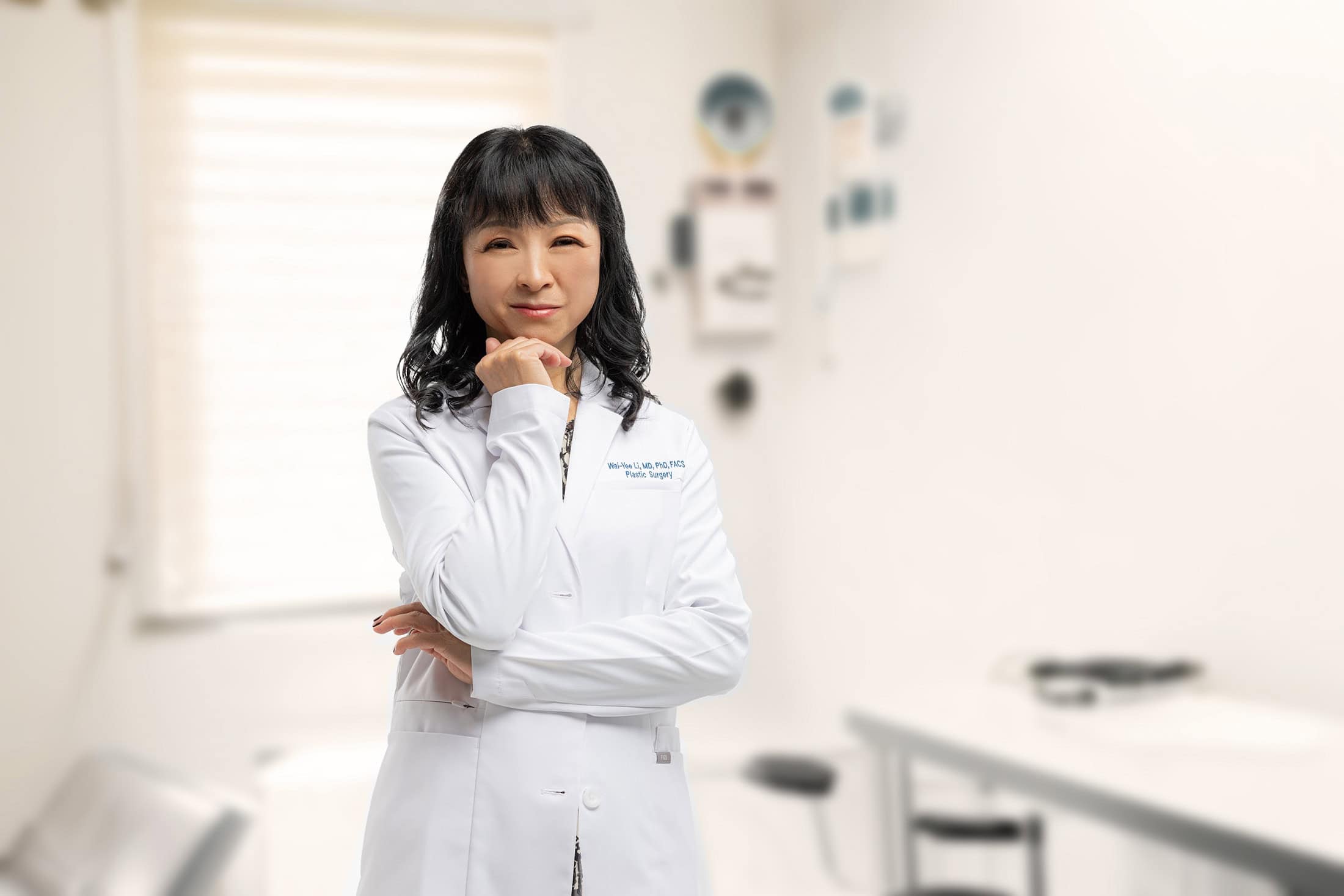
Meet your surgeon
Dr. Wai-Yee Li,
MD PhD FACS
A female board-certified plastic surgeon in Arcadia, Los Angeles, specializing in aesthetic and reconstructive breast surgery — with a focus on the best surgical outcomes, less pain and minimal scarring.
Meet Dr. Wai-Yee Li ›



Patient reviews
Rated 5.0 from 227+ reviews across Google, Yelp, Healthgrades & U.S. News
Read patient reviews ›Take the next step
Considering breast surgery?
Book a consultation with Dr. Wai-Yee Li, or call the practice to discuss your options.
Visit the practice
Two locations across Los Angeles
Arcadia
Get directions ›Pasadena
Pasadena, CA 91105