
Breast Lift (Mastopexy)
What does a breast lift (mastopexy) do?
A breast lift — mastopexy — lifts and reshapes your own breast tissue to restore a more youthful contour without implants, after pregnancy, weight loss, or implant removal. Dr. Wai-Yee Li performs mastopexy in Arcadia, Los Angeles, often combined with implant removal or reduction.
Pregnancy, weight loss, time, or the removal of breast implants can leave the breast sitting lower and feeling emptier than it once did. A breast lift — mastopexy — lifts and reshapes your own breast tissue to restore a higher, more youthful contour, without adding an implant. Dr. Li performs mastopexy in Arcadia and Pasadena, often on its own and often combined with implant removal or a reduction.
What is a breast lift (mastopexy)?
A breast lift is a surgical procedure that raises and reshapes the breast using the tissue you already have, rather than adding volume with an implant. Dr. Li removes excess, stretched skin, tightens the remaining skin envelope, and moves the nipple and areola to a higher, more natural position on the breast.
Surgeons describe how low the breast sits as 'ptosis' (droopiness), measured by where the breast and nipple fall relative to the 'inframammary fold' (IMF) — the crease under the breast where the wire sits in a wired bra. A lift is about that relationship: it changes the shape and position of the breast more than its size. If the real concern is being too large or too small, a different conversation fits better, and the consultation sorts out which one.
When does a breast lift help?
A mastopexy is worth considering whenever the breast has lost its shape or position but you are happy with — or want to keep — roughly the volume you have. It comes up most often in a handful of situations:
- After pregnancy and breastfeeding. Restoring shape and position once your family is complete, when the breast has stretched and settled lower.
- After significant weight loss. Including weight lost with GLP-1 medications, which often leaves loose, deflated breast skin that will not shrink back on its own.
- With implant removal. Many women who decide their implants should come out pair breast implant removal with a lift, sometimes with fat grafting, so the breast is reshaped rather than left empty.
- With, or instead of, a reduction. A breast reduction always includes a lift; when the goal is shape rather than a smaller size, a lift on its own may be all that is needed.
- With an implant — augmentation mastopexy. When a lift alone will not restore the upper fullness you want, an implant can be placed at the same time. This combination of a lift and a breast augmentation in one operation is called an augmentation mastopexy.
A lift is also used to match one breast to the other. Many women naturally have one breast lower or fuller than its partner, and a mastopexy on one side — a symmetrizing lift — can even them out.
Dr. Li's approach to breast lift surgery
Dr. Li is a breast specialist first: reshaping and reconstructing the breast is what she does on almost every operating day. Her mastopexy technique focuses on using your own tissue to rebuild fullness in the upper part of the breast, where volume is usually lost first. In selected patients she uses an auto-augmentation — repositioning your existing breast tissue to add fullness where it has emptied, with no implant at all.
When you want more fullness than your own tissue can give, she also performs augmentation mastopexy, combining the lift with a breast implant sized to the result you are after. Because a large part of her work is reconstructing breasts and correcting implant problems, she will give you an honest read on whether a lift alone meets your goal or whether volume — your own or an implant — is part of the answer.
That judgment is built on her reconstructive background. Reshaping the breast at the same time a cancer is treated — oncoplastic surgery — is part of her everyday reconstructive practice, and that same discipline informs how she lifts and reshapes your own tissue. You can read more about that work on the breast reconstruction page.
Is a breast lift right for me?
Whether a breast lift is right for you is decided at your consultation, in person — not from a web page. In general, a mastopexy suits someone in good enough health for surgery who wants to raise and reshape the breast and accepts that reshaping leaves scars in exchange for a better contour.
A few things shape the timing and the plan. Many women choose a lift once their family is complete, or once their weight has been stable for a while after major weight loss, so the result lasts. If you smoke or vape, you will need to stop all nicotine — including gum and patches — for at least eight weeks before surgery, because nicotine blocks wound healing. And it helps to be clear on your real goal: a lift changes shape and position, not size, so the consultation is where lift-alone, lift-with-an-implant, and reduction are sorted out honestly.
Dr. Li will listen to what you want first, examine you, take standard measurements, and tell you plainly what a lift can and cannot do for your anatomy. If a lift is not the right operation for your goal, she will say so.
What happens during a breast lift?
A breast lift is an outpatient surgery, usually performed under general anesthesia, and most patients go home the same day. Before anything is scheduled, Dr. Li reviews your goals and medical history, takes photographs for your chart that do not include your face, and explains the plan and its trade-offs, often using photos and diagrams so you understand what is involved.
During the operation, Dr. Li removes the excess skin, tightens the skin envelope, and reshapes the breast, moving the nipple and areola to a higher position. In almost all lifts the nipple stays attached to its own blood supply — the 'pedicle' — so it remains living, sensate tissue rather than being detached. She closes the incisions in layers with buried, dissolvable stitches, which is what gives a fine-line scar rather than visible stitch marks.
As with any surgery under general anesthesia, a lift carries the standard risks of bleeding, infection, and scarring, along with the possibility of changed sensation in the nipple or skin, since the nipple is repositioned. If future breastfeeding matters to you, raise it at your consultation — moving the nipple can affect it, and it is worth discussing. Dr. Li goes through these honestly so there are no surprises.
Will a breast lift leave scars?
Yes. Reshaping the breast means scars, and Dr. Li is straightforward about that from the start. Trading a scar for a lifted, better-supported shape is the honest heart of the operation, and how much scar you have depends on how much skin needs to come out.
Mastopexy scars follow a few well-established patterns, chosen to match the amount of lift you need:
- Around the areola. For a small lift, the scar can sometimes be limited to a circle around the edge of the areola.
- The 'lollipop'. A scar around the areola with a single vertical line down to the fold, used for a moderate lift.
- The 'anchor'. The lollipop pattern plus a scar along the inframammary fold, for a larger lift with more skin to remove.
Dr. Li places these incisions where a bra or swimwear will cover them and closes them in layers. Scars are permanent, but in the majority of patients they fade over time into fine lines. No honest surgeon can promise a scarless lift, and she will show you what to realistically expect for your skin and your degree of lift.
What is recovery like after a breast lift?
Recovery from a breast lift is guided by Dr. Li and her team, and most patients return to normal activity gradually over the following weeks rather than all at once. Because a mastopexy reshapes the tissue you already have, the specifics — how you will feel, when you can drive, and when you can exercise again — are set out for your particular surgery, not from a generic timeline.
In general terms, you can expect some soreness and tightness in the first days, managed with the plan Dr. Li gives you, along with a supportive surgical bra to hold the new shape while it settles and a period of avoiding heavy lifting and strenuous or upper-body exercise until she clears you. You will be seen in follow-up so she can check your healing and guide you back to full activity at the right pace. If a question comes up between visits, her team is there to answer it.
Why choose Dr. Li for a breast lift?
Dr. Li is a female, board-certified plastic surgeon — MD, PhD, FACS — who spent ten years at a busy cancer center on the West Coast of southern California before opening her own practice. That decade was spent reshaping and rebuilding breasts, which is the same skill set a good lift draws on: judging shape, moving the nipple safely, and placing scars well.
She trained in her residency at the University of Southern California and runs an all-women practice, which many patients find more comfortable for intimate surgery. As a woman herself and a mother of two, she understands how much the shape of your breasts can matter to how you feel, and she is honest and direct about what surgery can realistically achieve. You can read more about her background on Dr. Wai-Yee Li's page.
See real breast lift results
The breast lift gallery shows Dr. Li's own patients, including lifts after major weight loss, photographed before and after.
To find out whether a breast lift is right for you, book a consultation with Dr. Li in Arcadia or Pasadena, or call 626.888.9728.
Frequently asked questions
No. A mastopexy lifts and reshapes your own tissue. When more upper fullness is wanted, Dr. Li can use an auto-augmentation technique that repositions your existing tissue — still with no implant.
Yes, and it is one of the most common pairings — the implants come out and the breast is reshaped in the same operation.
A lift changes shape and position more than size. If size is the concern, a reduction or augmentation conversation may fit better — the consultation sorts out which path matches your goal.
Reshaping the breast means scars, and Dr. Li is honest about that. The pattern depends on how much skin must be removed — a circle around the areola for a small lift, a ‘lollipop’ that adds a vertical line for a moderate lift, or an ‘anchor’ that adds a scar along the crease under the breast for a larger one. She places them where a bra hides them, and in most patients they fade to fine lines over time.
An augmentation mastopexy combines a breast lift with a breast implant in a single operation. It is the right choice when a lift alone will not restore the upper fullness you want. Dr. Li lifts and reshapes your own tissue and places an implant sized to your goal at the same time, so droop and volume are addressed together rather than in two surgeries.
A breast reduction already includes a lift — removing tissue to make the breast smaller and reshaping it higher are part of the same operation. A standalone lift is for women who are happy with their size but want the breast raised and reshaped. Which one fits depends on whether size or shape is your main concern, and the consultation sorts that out.
Yes. If you smoke or vape, you will need to stop all nicotine — including gum and patches — for at least eight weeks before surgery. Nicotine blocks wound healing, which matters in an operation that relies on skin and tissue healing well around a new shape. Dr. Li reviews your health and this requirement with you at consultation.
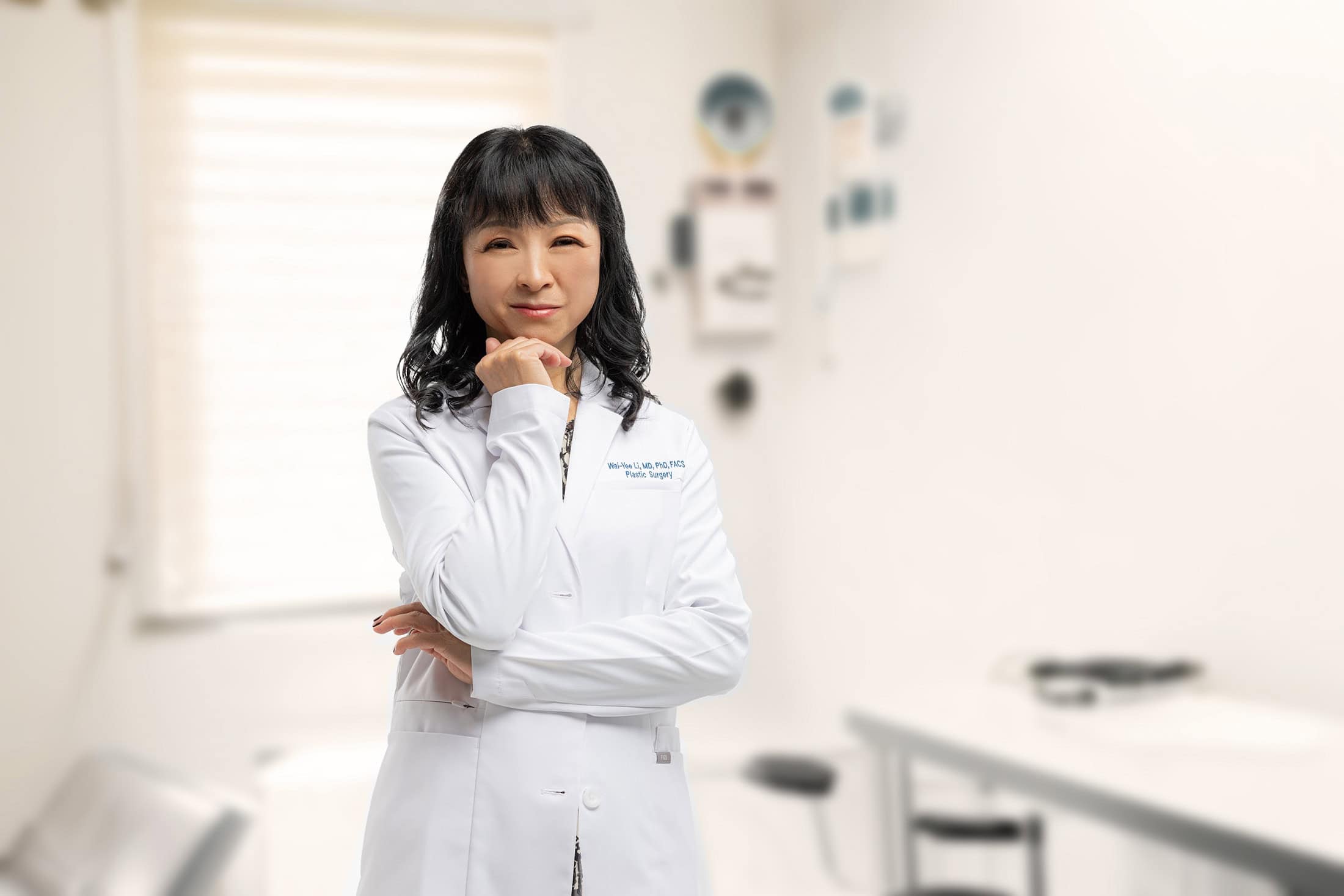
Meet your surgeon
Dr. Wai-Yee Li,
MD PhD FACS
A female board-certified plastic surgeon in Arcadia, Los Angeles, specializing in aesthetic and reconstructive breast surgery — with a focus on the best surgical outcomes, less pain and minimal scarring.
Meet Dr. Wai-Yee Li ›



Patient reviews
Rated 5.0 from 227+ reviews across Google, Yelp, Healthgrades & U.S. News
Read patient reviews ›Take the next step
Considering breast surgery?
Book a consultation with Dr. Wai-Yee Li, or call the practice to discuss your options.
Visit the practice
Two locations across Los Angeles
Arcadia
Get directions ›Pasadena
Pasadena, CA 91105