
Breast Augmentation
How does Dr. Li approach breast augmentation?
Breast augmentation at LA Breast & Body pairs implants with honest sizing guidance: Dr. Wai-Yee Li is a breast specialist who spends her surgical life reconstructing breasts and correcting implant problems, so sizes and placement are chosen to look natural and age well — judgment and safety over glamour.
Breast augmentation enlarges and reshapes the breast with implants. At LA Breast & Body it comes with something rarer than the surgery itself: honest sizing guidance from a breast specialist who has seen — and fixed — every way implants can go wrong. Dr. Li spends most of her surgical life reconstructing breasts and correcting implant problems, so an augmentation with her is planned around judgment and safety rather than glamour.
What is breast augmentation?
Breast augmentation is a surgical procedure that increases breast size and improves breast shape by placing an implant on each side. A breast implant is a manufactured device with two parts: an outer shell and a filling of either silicone gel or saline (salt water). These are the same implants used across breast surgery, including reconstruction after mastectomy — which means the device choices, the trade-offs, and the long-term care are all things Dr. Li works with every week.
Augmentation changes size and upper-body proportion. It does not, on its own, lift a breast that has descended, and it is not a treatment for sagging. Sorting out whether you want more volume, a lift, or both is one of the first things a consultation clarifies.
Dr. Li's approach: judgment first, implants second
Dr. Li spends most of her surgical life reconstructing breasts and correcting problems created elsewhere: capsular contracture, implants too large for the tissue meant to hold them, and results that looked right on a screen and wrong in a body. That experience shapes how she plans an augmentation. Implant size and position are chosen to look natural and age well, not just to photograph well in the first year.
The practical version of that philosophy is restraint about size. An implant heavier than the tissue can support will, over years, stretch that tissue, ride low, and thin the skin — setting up the very revision problems Dr. Li spends her days fixing. She gives honest guidance about what your body can carry comfortably over decades, even when that guidance is more conservative than a patient first has in mind. As a woman herself, she takes the goal of a breast size and shape you are proud of seriously, and she is direct about what will, and will not, get you there safely.
Saline or silicone — which implant is right?
Both saline and silicone implants are FDA-approved and widely used; the difference is what fills the shell and how each behaves. Silicone gel implants look and feel more like natural breast tissue, which is why they are the common choice, especially when there is little of a patient's own tissue to cover the implant. Saline implants are filled with sterile salt water. They cost less, and if the shell leaks, the implant simply deflates and the body harmlessly absorbs the saline — a leak you notice quickly. Their drawback is 'rippling,' a visible wrinkling of the implant surface.
Rippling matters less in augmentation than in reconstruction, because in an augmentation your own breast tissue lies over the implant and helps hide it; after a mastectomy there is only skin and a thin layer of tissue for cover. Dr. Li works only with FDA-approved devices, including implants from the two largest manufacturers, Allergan and Mentor, as well as Motiva — a silicone implant made as a single piece rather than a separate shell and filling, and FDA-approved for cosmetic augmentation. Which device suits you is decided together at consultation.
How are implant size and profile decided?
Implant volume is measured in cubic centimeters (cc), and implants come in a wide range. The smallest is around 80 cc, and until recently the largest silicone implant was 800 cc; in May 2025 the FDA approved the Mentor MemoryGel Enhance, which reaches 930 to 1445 cc. Implants also come in different 'profiles,' or projections — how far the implant stands out from the chest for a given width. A higher-profile implant projects more; a lower-profile implant sits flatter and wider.
Numbers on a chart, though, are not the same as the right implant for your body. The size and profile that suit you depend on your chest width, your existing breast tissue, and your goals — and, in Dr. Li's practice, on what your tissue can support comfortably for the long term. During the consultation she will have you try sizers and talk through the trade-offs rather than promise a cup size, because the honest answer comes from your anatomy, not a catalog.
Which implant brands does Dr. Li offer?
Dr. Li works with all three major FDA-approved breast implant brands — Allergan, Mentor, and Motiva — and is experienced with each. No single brand is right for every patient: the choice depends on your anatomy, the look and feel you want, and the specifics discussed at your consultation. Because Dr. Li is not tied to one manufacturer, the recommendation she makes is based on what fits you, not on what is on the shelf.
In addition, Dr. Li has experience with the Mentor MemoryGel Enhance range — larger-volume implants, from 930 cc up to 1445 cc, designed for patients who need more than the standard 800 cc maximum. Enhance implants are currently FDA-approved for breast reconstruction after mastectomy; their use in cosmetic augmentation is what is known as 'off-label,' meaning the FDA has approved the device, but not for this specific purpose. Off-label use is a legal and common part of medical practice, but it is never a casual decision. Dr. Li will consider Enhance for select augmentation patients only after a detailed consultation covering the risks, the benefits, and the alternatives. If you have been told you are "too large" for standard implants, this is a conversation worth having in person.
Disclosure: Dr. Li serves as a paid consultant on the advisory board of Allergan Aesthetics (an AbbVie company) for breast reconstruction devices. She discloses this in the interest of transparency; it plays no part in which implant brand she recommends for any individual patient — that decision is based solely on your anatomy and your goals.
Smooth or textured implants?
Dr. Li uses smooth implants. She does not recommend textured implants and has never used them. Textured implants have a rough, sandpaper-like coating that was designed — originally for cosmetic augmentation — to reduce 'capsular contracture,' the thick scar tissue that can form around an implant and make the breast feel hard. Over the past decade, however, textured surfaces have been linked to a rare cancer called anaplastic large cell lymphoma (ALCL).
That link led to a recall. In 2019, at the FDA's request, Allergan recalled its Biocell textured breast implants because of the ALCL association. Textured implants remain available and are still popular in parts of Europe, but Dr. Li's position is settled: the small potential benefit does not justify a risk that smooth implants avoid. It is also why she uses round implants — the most common shape — rather than teardrop-shaped ones, which are usually textured and tend to feel firmer.
Should the implant go above or below the muscle?
The implant can be placed above the chest muscle or beneath it, and the two planes behave differently. In normal anatomy the breast sits above the 'pectoralis major,' the large fan-shaped muscle of the chest. A 'subpectoral' implant goes under that muscle; a 'prepectoral' implant goes above it, where the breast tissue naturally lives.
Dr. Li's preference in recent years has moved toward prepectoral placement. Putting the implant above the muscle is more anatomical, and it avoids 'animation deformity' — the visible twitch or jump an under-the-muscle implant makes when the chest muscle flexes. It also spares the muscle from being cut, which can mean less pain. The trade-off is coverage: above the muscle there is less tissue over the implant, so in a thin patient the edges can show, particularly across the top. Placement under the muscle gives more cushioning there, which is one reason subpectoral has long been common in cosmetic augmentation. There is no single right answer — the plane is chosen for your body and your tissue, and Dr. Li explains why she recommends one over the other for you.
Is breast augmentation right for me?
Whether breast augmentation is right for you is decided in a consultation, not on a web page. In general, good candidates are healthy adults bothered by breast size or proportion, who understand what implants can and cannot do and hold realistic expectations. If the breast also sags, an implant alone will not raise it — in that case augmentation is often combined with a breast lift in one operation, a pairing known as augmentation-mastopexy.
Smoking and every form of nicotine — cigarettes, vaping, nicotine gum, and patches — interfere with wound healing and have to stop in the weeks leading up to surgery; Dr. Li will tell you exactly how far ahead. She reviews your medical history, examines you, and will say plainly when a different procedure, or no surgery at all, is the better answer. Candidacy is never something she promises in advance.
What happens during breast augmentation?
Breast augmentation is usually performed under general anesthesia, most often as an outpatient procedure, so many patients go home the same day. Dr. Li places the implant through a discreet incision — commonly in the 'inframammary fold' (IMF), the natural crease beneath the breast — and positions it in the plane the two of you chose. During surgery she can use temporary sizers to confirm the volume and shape before the final implant goes in, rather than committing to a number decided only on paper.
Because these are the same implants and many of the same techniques she uses in reconstruction, the planning is meticulous: incision placement to keep scars discreet, careful handling of the tissue, and layered closure. Every surgery carries general risks — bleeding, infection, changes in nipple or skin sensation, scarring, and some asymmetry — and Dr. Li goes through the ones relevant to you before you decide.
What is recovery like?
Recovery from breast augmentation is individual, and Dr. Li and her team guide you through every stage of it. Most patients feel tight and sore across the chest for the first several days as the tissue settles around the new implant, with the discomfort easing steadily after that. You return to normal activity gradually rather than all at once.
Dr. Li gives you specific, personal instructions on what to lift, when to resume exercise, and how to support the breasts while they heal — guidance tailored to your surgery rather than a generic timeline. Following those restrictions is part of getting a result that lasts. Your follow-up visits are where she checks that the implants are settling as expected.
Breast implants are not lifetime devices
Breast implants are not permanent, and it is more honest to plan for that from the start than to be surprised by it later. Many women who had an augmentation years ago come back with aging implants and have them exchanged — the old implants removed and new ones put in — whether because the implants are simply old, because a size or shape no longer fits their life, or because of a problem such as capsular contracture or a leak. Dr. Li performs this implant exchange regularly. It is a routine part of her revision work, not a sign that something went wrong.
Rather than assign implants a fixed expiration date, Dr. Li monitors them over time — silicone implants can rupture silently, so imaging is used to check on them — and addresses them when there is a reason to. If your implants are aging, or you want a different size, swapping old implants for new is handled as revision breast augmentation, which also corrects capsular contracture and implant malposition. If an implant may have failed, breast implant rupture explains how it is confirmed and what happens next. And if you would rather your implants come out — with or without new ones in their place — that is breast implant removal.
Alternatives and results
An implant is not the only way to add volume. For a smaller, natural change, fat grafting moves your own fat from another area to the breast with no implant at all, though larger changes are usually better served by an implant or a combination of the two. Dr. Li is candid at consultation about which option is honest for your anatomy and your goal. To get a sense of what her breast surgery results look like, browse the gallery.
Why choose Dr. Li for breast augmentation?
Dr. Wai-Yee Li is a board-certified plastic surgeon — MD, PhD, FACS — who spent ten years at a busy cancer center building deep experience in breast surgery before opening her all-women private practice, LA Breast & Body. Her core work is breast reconstruction, and she regularly revises implant results that did not go well the first time. That is an unusual background to bring to a cosmetic augmentation, and it is the whole point: the surgeon choosing your implant is the same one who spends her days seeing how implants behave years later.
She is honest and direct — she will tell you what is realistic and what is not — and her practice is built as a safe, comfortable space, with an all-women team from the front desk to the operating room. You can read more about her training and background on Dr. Li's profile.
To find out whether breast augmentation is right for you, book a consultation with Dr. Li in Arcadia or Pasadena, or call 626.888.9728.
Frequently asked questions
Around your anatomy and your goals together: what your tissue can support comfortably for decades, not just at the reveal. Dr. Li gives honest guidance drawn from years of correcting oversized and misplaced implants.
No. Implants can need monitoring, maintenance, or eventual replacement, and Dr. Li explains what that can involve before you decide — not after.
That is revision augmentation — correcting capsular contracture, malposition, rupture, or size — described on its own page.
Neither is universally better; they behave differently. Silicone gel implants look and feel closer to natural breast tissue and are the more common choice. Saline implants, filled with sterile salt water, cost less and deflate obviously if they leak, so a leak is easy to spot — but they are more prone to visible rippling. Both are FDA-approved, and Dr. Li helps you weigh the trade-offs against your own tissue at consultation.
No. Dr. Li uses smooth implants and has never used textured ones. Textured implants have a rough coating originally meant to reduce capsular contracture, but over the past decade they have been linked to a rare cancer, anaplastic large cell lymphoma (ALCL). In 2019 the FDA prompted Allergan to recall its Biocell textured implants over that link, and Dr. Li considers the smooth-implant option the safer choice.
Either is possible. A subpectoral implant sits under the chest muscle; a prepectoral implant sits above it, where breast tissue naturally lies. Dr. Li’s preference in recent years leans prepectoral, because it is more anatomical and avoids the muscle “twitch,” or animation deformity, seen with under-the-muscle implants. Placement under the muscle, though, gives thin patients more cover. The right plane is chosen for your body at consultation.
Yes, silicone implants do. Because a silicone implant can rupture silently — with no change you can see or feel — the FDA recommends monitoring with MRI or high-resolution ultrasound starting five years after surgery and repeating every two to three years. Saline leaks are obvious and need no imaging. Dr. Li offers in-office ultrasound and goes through this schedule with you.
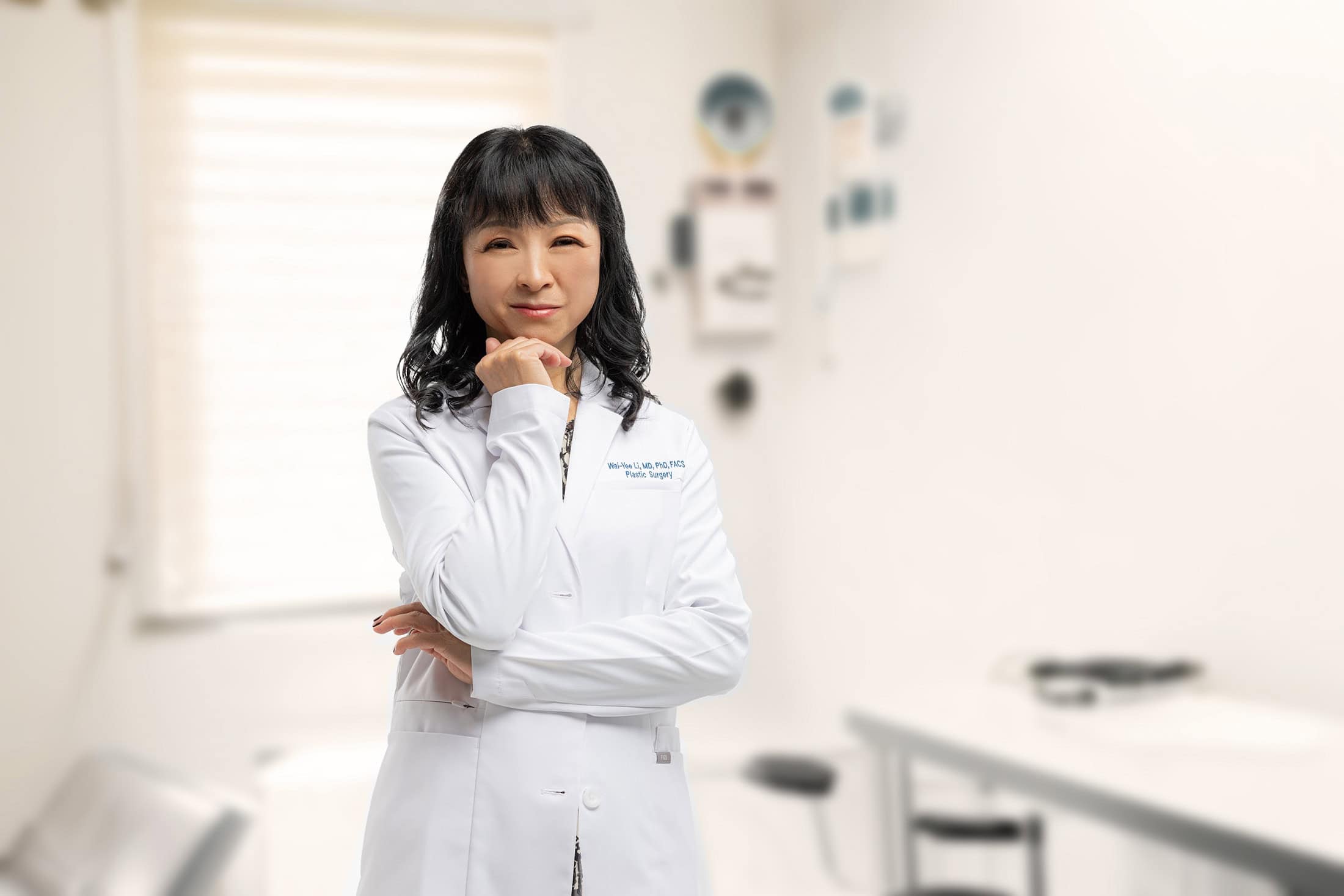
Meet your surgeon
Dr. Wai-Yee Li,
MD PhD FACS
A female board-certified plastic surgeon in Arcadia, Los Angeles, specializing in aesthetic and reconstructive breast surgery — with a focus on the best surgical outcomes, less pain and minimal scarring.
Meet Dr. Wai-Yee Li ›



Patient reviews
Rated 5.0 from 227+ reviews across Google, Yelp, Healthgrades & U.S. News
Read patient reviews ›Take the next step
Considering breast surgery?
Book a consultation with Dr. Wai-Yee Li, or call the practice to discuss your options.
Visit the practice
Two locations across Los Angeles
Arcadia
Get directions ›Pasadena
Pasadena, CA 91105