
Fat Grafting (Fat Transfer)
What is fat grafting used for in breast surgery?
Fat grafting moves your own fat, harvested by liposuction, to where volume is needed — refining breast reconstruction, softening the edges of an implant, restoring shape after implant removal, or enhancing the breast with no implant at all. Dr. Wai-Yee Li performs it in Los Angeles.
Fat grafting — also called fat transfer — uses your own fat, harvested by liposuction, cleaned, and reinjected to add natural volume exactly where it is needed. In breast surgery it is one of the most versatile tools available, because it adds shape and softness without an implant and without anything manufactured — just your own living tissue moved to where it does more good. Dr. Li uses fat grafting most often as a refinement: polishing a breast reconstruction, softening the visible edge of an implant, restoring fullness after implants are removed, or adding modest, natural volume when a patient wants no implant at all.
What is fat grafting (fat transfer)?
Fat grafting, or fat transfer, is a procedure that relocates a patient's own fat from one area of the body to another to add volume and improve contour. It works in three basic steps. First, fat is harvested gently by liposuction from an area with fat to spare — commonly the abdomen, flanks, or thighs. Next, that fat is cleaned and concentrated to separate the usable fat from fluid and other material. Finally, the prepared fat is injected in fine layers, through small entry points, into the area that needs volume.
Because grafted fat is living tissue rather than a manufactured device, it has to establish a new blood supply in its new home to survive. Placing it in thin passes, rather than in one large pocket, gives more of the fat contact with the surrounding tissue and its blood supply. A portion of the transferred fat takes and becomes permanent; some is naturally reabsorbed by the body in the months after surgery. This is normal and expected, and it is the reason fat grafting is always planned around the fact that not every cell survives.
How does Dr. Li use fat grafting?
In Dr. Li's practice, fat grafting is primarily a refinement tool — a way to perfect the shape and softness of a breast, rather than a stand-alone way to make it dramatically larger. Her background is in breast reconstruction and cancer surgery, and fat transfer fits naturally alongside that work. The most common ways she uses it include:
- Refining a breast reconstruction. After breast reconstruction, small volumes of fat can smooth contour irregularities, fill hollows or dents, and blend the edges of a reconstructed breast so the final result looks and feels more natural.
- Softening the edge of an implant. In slimmer patients especially, the upper border of an implant can be visible or can ripple. A layer of the patient's own fat placed over that border softens the transition between the implant and natural tissue — a common finishing step in breast augmentation and implant revision.
- Restoring shape after implants are removed. When implants come out, the breast can look deflated. Fat grafting is one way to bring back softness and volume, which is why it is often planned as part of breast implant removal rather than left as an afterthought.
- Enhancing shape with no implant at all. For a modest, natural-feeling increase in fullness, fat alone can improve the breast with nothing artificial added — an option some patients strongly prefer.
Fat grafting is also frequently combined with other breast surgery — for example, alongside a breast lift to add fullness where a lift alone would leave the upper breast flat. Which combination makes sense is decided together at consultation, not settled in advance.
Your own tissue, nothing artificial
A defining advantage of fat grafting is that it uses only your own tissue — there is no implant, no synthetic filler, and nothing manufactured left in the body. For many patients that is the whole appeal. Women who have chosen to have their implants removed because they no longer want a device inside them are often relieved to learn that softness and volume can be restored with their own fat instead. Because the material is your own, the body does not reject it, and the tissue changes naturally with you over time.
It is honest to name the limit as well: fat grafting will not create the same projection or upper-pole fullness that an implant can, and no surgeon should pretend otherwise. For a large increase in size, an implant — or a combination of an implant and fat — is usually the better answer. For a natural refinement, using your own tissue is a genuine advantage rather than a compromise.
Will grafted fat last, and will I need more than one session?
The fat that successfully establishes a blood supply becomes permanent, living tissue — it is truly yours, and it stays. Some of the grafted fat, however, is naturally reabsorbed in the months after surgery, and how much varies from person to person. Dr. Li plans for this in two ways: by placing the fat thoughtfully so that as much of it as possible gets the blood supply it needs, and by being candid about whether a single session will meet your goal or whether a second, touch-up session may be sensible.
She does not promise that a precise amount of fat will survive, because no honest surgeon can — the body ultimately decides. What she can do is set realistic expectations up front and plan the treatment around them, so the outcome is one you understood before surgery rather than a surprise afterward.
One harvest, two areas improved
Fat grafting has a built-in second benefit: the area the fat is taken from is contoured by the liposuction itself. So the donor site — often the abdomen, flanks, or thighs — is slimmed at the same time the breast gains volume. Many patients appreciate that a single procedure both refines the breast and reshapes a stubborn area elsewhere. Which donor areas make sense to use, and how much can reasonably be taken, is part of the consultation conversation and depends on where you actually carry fat to spare.
Is fat grafting right for me?
Whether fat grafting is the right choice depends on your goal, your anatomy, and how much fat you have available to harvest — and that is determined at consultation, not from a web page. Fat transfer tends to suit patients who want a natural, modest refinement in shape or softness, or a way to add volume without a device. It is less suited to patients who want a large increase in size, where an implant or a combination of fat and an implant may serve the goal better. Very slim patients may simply not have enough fat to harvest for a meaningful result.
During your consultation, Dr. Li examines you, listens to what you are hoping to achieve, and gives you a straight answer about whether fat grafting, an implant, or a combination is the honest route to your goal. Candidacy is decided in person, taking your full medical history into account — never assumed in advance.
What happens during fat grafting?
Fat grafting is a surgical procedure, and depending on how much fat is being transferred and whether it is combined with another operation, it may be performed under general or local anesthesia. The liposuction harvest is carried out through very small access points rather than long incisions, so the marks left at the donor site are minimal. Once the fat has been prepared, it is injected through small entry points into the breast in many fine passes, to distribute it evenly and give it the best chance to survive.
As with any surgery, general risks such as bleeding, infection, and changes in sensation apply, and Dr. Li reviews these with you beforehand. Because fat grafting depends so heavily on the transferred tissue building a healthy blood supply, stopping all nicotine — smoking, vaping, gum, and patches all count — for at least eight weeks before surgery matters even more than usual, since nicotine constricts blood vessels and works directly against graft survival.
What is recovery like?
Recovery from fat grafting involves two areas rather than one: the breast where fat was placed, and the donor site where it was harvested. The donor site typically feels much like recovery from liposuction — sore and bruised for a period that varies from person to person — while the grafted breast is swollen at first, which means the early result looks fuller than the final one will. Dr. Li and her team guide you through recovery and follow-up, and most patients return to their normal routine gradually rather than all at once.
Because some settling and reabsorption happen over the following months, the true result of fat grafting is judged not on the first day but once everything has healed and settled. That longer view is part of why Dr. Li offers attentive follow-up and plans the amount of fat placed with the final, settled result in mind.
Why choose Dr. Li for fat grafting?
Fat grafting rewards judgment and experience, because so much of the result depends on placing the fat well and setting honest expectations. Dr. Wai-Yee Li is a board-certified plastic surgeon — MD, PhD, FACS — who spent ten years at a busy cancer center specializing in complex breast reconstruction before opening LA Breast & Body, her all-women private practice in Arcadia and Pasadena.
That reconstructive background is exactly where fat grafting lives: refining and finishing breast results, working with a patient's own tissue, and knowing when fat is the right tool and when it is not. Dr. Li is honest and direct about what fat transfer can and cannot achieve, and she plans each case around your goals rather than a formula. Her all-women practice is designed to be a comfortable, unhurried space for these personal conversations.
The honest limits
There is a ceiling on how much fat will successfully take in a single session — placing more does not mean keeping more. For those seeking a high-volume result, several serial procedures are often needed, spaced apart so each round of grafted fat can establish its own blood supply before the next. You also need enough to give: Dr. Li can only graft what your donor areas can provide, so a sufficient donor site is a genuine requirement, not a formality. If your frame doesn't carry enough spare fat to reach your goal, she will say so plainly — and that is exactly where the conversation about an implant, or a combination of both, begins.
To find out whether fat grafting is right for you, book a consultation with Dr. Li in Arcadia or Pasadena, or call 626.888.9728.
Frequently asked questions
The portion of grafted fat that takes a blood supply is permanent living tissue; some is naturally absorbed in the first months. Dr. Li plans the amount placed around that, and discusses whether a second round makes sense for your goal.
Gentle liposuction of areas with fat to spare — commonly the abdomen, flanks, or thighs — which slims the donor area as a side benefit.
For modest, natural-feeling volume, yes. For larger changes, an implant or a combination may serve the goal better — the consultation sorts out which is honest for your anatomy.
Often, yes. When an implant’s upper border is visible or ripples — most common in slimmer patients with little natural tissue over the implant — a layer of your own fat placed over that edge softens the transition and makes it look and feel more natural. Dr. Li uses fat grafting this way as a finishing step in breast augmentation and implant revision, deciding at consultation whether it suits your tissue.
Yes. When implants are removed, the breast can look deflated, and fat grafting is one of the ways Dr. Li restores softness and volume using your own tissue instead of another device. It is frequently planned as part of the removal itself rather than a separate step. Whether fat alone is enough, or a lift is also needed, depends on your tissue and is decided together at consultation.
Fat grafting can create small areas of calcification or fat necrosis that show up on a mammogram. Experienced breast radiologists are generally able to distinguish these benign changes from findings that need further attention, especially when they know fat grafting was performed. Always tell the radiologist reading your mammogram that you have had fat transfer, and review your screening history with Dr. Li at consultation.
Recovery involves two areas: the breast where fat was placed and the donor site where it was harvested by liposuction. The donor site is typically sore and bruised for a while, and the breast is swollen at first, so the early result looks fuller than the final one. Dr. Li and her team guide your recovery, and most patients return to normal activity gradually. Some settling happens over the following months.
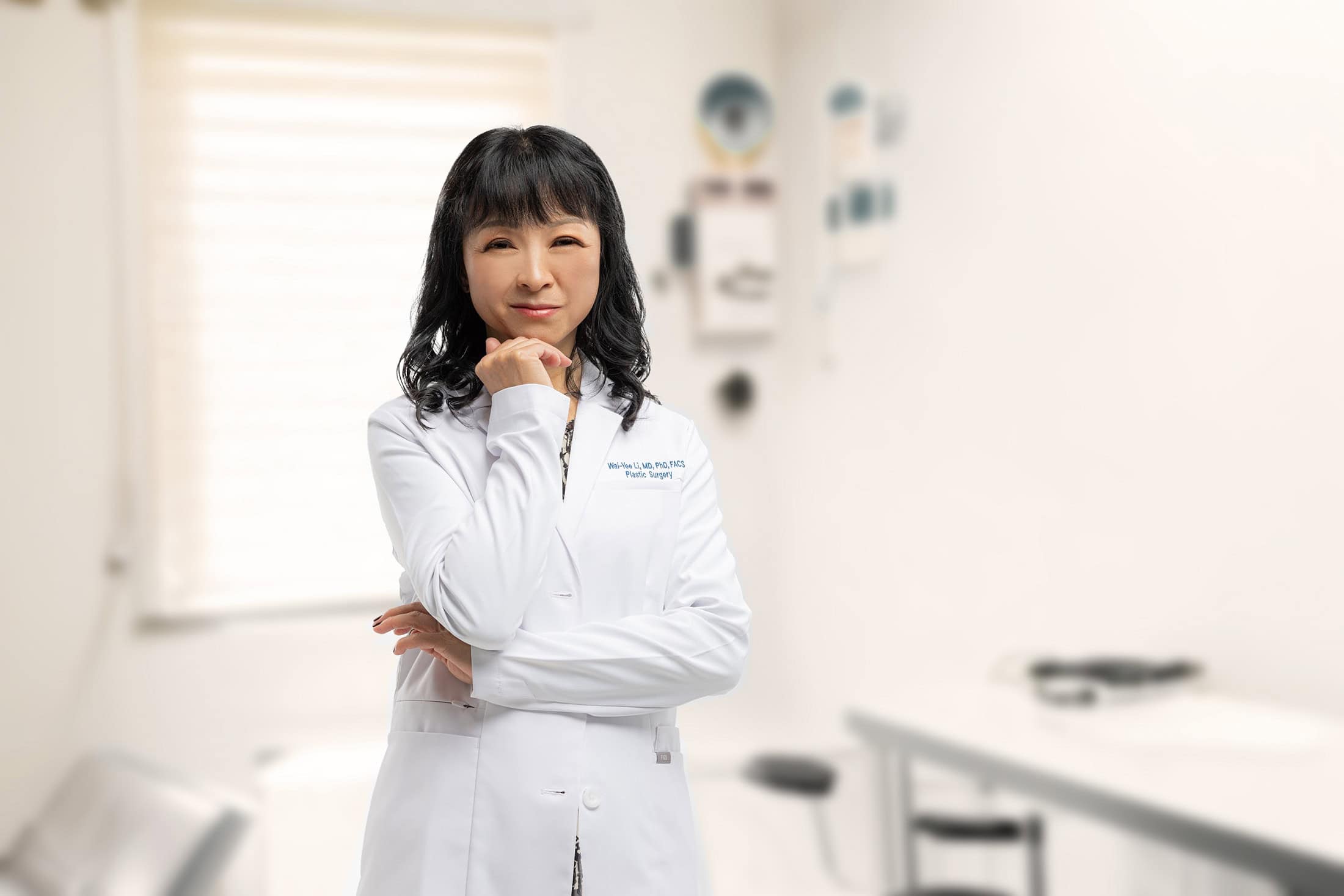
Meet your surgeon
Dr. Wai-Yee Li,
MD PhD FACS
A female board-certified plastic surgeon in Arcadia, Los Angeles, specializing in aesthetic and reconstructive breast surgery — with a focus on the best surgical outcomes, less pain and minimal scarring.
Meet Dr. Wai-Yee Li ›



Patient reviews
Rated 5.0 from 227+ reviews across Google, Yelp, Healthgrades & U.S. News
Read patient reviews ›Take the next step
Considering breast surgery?
Book a consultation with Dr. Wai-Yee Li, or call the practice to discuss your options.
Visit the practice
Two locations across Los Angeles
Arcadia
Get directions ›Pasadena
Pasadena, CA 91105